


DIY Projects
Product Categories
Beyond the Algorithm: How to Choose LED Strip Connectors That Actually Last
You spend hours choosing the right LED strip. You measure the run, match the color temperature, plan the layout down to the last inch. A few weeks later, the strip starts flickering. One section goes dark. The joint where two runs meet feels warm to the touch. Nothing about the strip itself has changed — the failure is almost always in the smallest, cheapest part of the system: the LED strip connector.
Online marketplaces are flooded with connectors that look nearly identical and cost next to nothing. Search algorithms and sponsored placements tend to push these low-cost options to the top, while connectors built to a real electrical spec get buried a few pages down. This isn’t a roundup of specific brands or a “top 5” list — it’s a framework, the same questions an engineer would ask, for judging any solderless LED connector on its materials, its design, and the numbers on its spec sheet, so you can tell durable from disposable before you install it.
We’ve been in LED hardware since 2009, and have worked specifically on LED strip and connector sourcing since 2015. Our connectors carry CE and RoHS certification, and we work directly with the factories that build them — which is also where most of what follows comes from: watching which failures keep recurring, and which design choices actually prevent them.
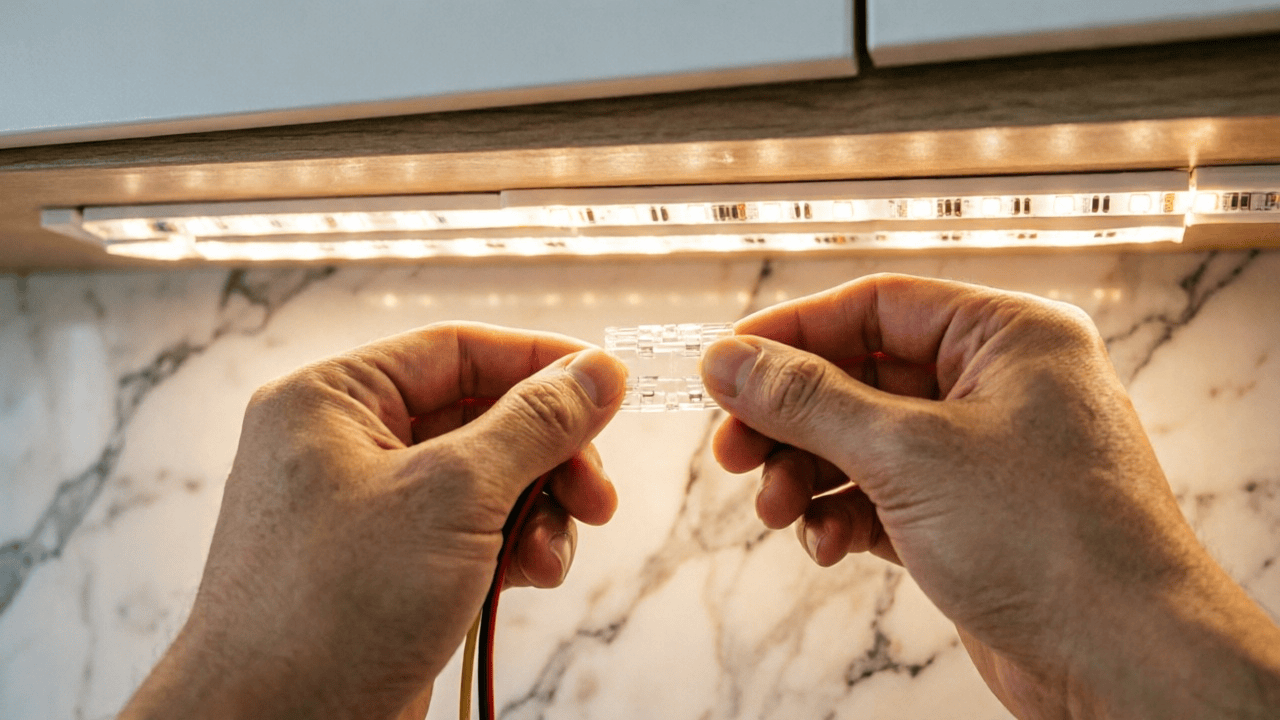
led-strip-connectors
What Is an LED Strip Connector — and Why Do Cheap Ones Fail?
An LED strip connector is the small clip, clamp, or piercing joint that links two sections of LED tape, or links a strip to its power wire, without soldering. It’s also the single most common point of failure in an LED lighting install. Most failures trace back to one of four physical weaknesses. Understanding them makes it much easier to recognize a bad design before it’s in your wall or ceiling.
Insufficient contact pressure
Many low-cost connectors rely on a thin, simple metal spring leaf to hold the strip’s copper pads against the contact pin. That spring pressure isn’t constant. Thermal cycling and ordinary metal fatigue relax it over time. As pressure drops, a microscopic gap opens between the pin and the pad — and that gap is what shows up as flickering or a dead section.
Substandard contact metal
A well-made connector uses tin- or gold-plated phosphor bronze for its contacts: an alloy chosen specifically because it conducts well and resists the kind of fatigue described above. Cheaper alternatives often substitute recycled copper alloys or even plain steel, both of which carry higher resistance and oxidize faster.
Fragile housing
Housings on quality connectors are typically flame-retardant polycarbonate (PC), which tolerates heat and UV exposure without becoming brittle. Budget housings frequently use generic, unrated plastics that stiffen and crack after a season of temperature swings or sun exposure.
Voltage drop and heat
Every one of these weaknesses converges on the same failure mode: higher resistance at the contact point means more heat generated there, since dissipated power rises with the square of the current passing through it. This isn’t from our own lab — it’s the range you’ll find across public connector-engineering references: a well-made contact typically sits at a few tenths of a milliohm up to a few milliohms; a degraded or poorly made one can drift into the tens of milliohms. In demanding applications, engineers often apply additional current derating margins to account for aging, temperature rise, and exactly this kind of contact-resistance growth over time. On a densely populated 24V — or especially 12V — strip run pulling real current, that localized heating can be enough to soften or melt a cheap housing. That’s a fire risk, not just an inconvenience.
How to Choose an LED Strip Connector: Specifications That Actually Matter
Reading a connector’s spec sheet the way an engineer would takes only a few extra seconds, and it’s the single best filter available before you buy.
- Current rating:Confirm the connector’s rated current in amperes. For higher-power strips, look for a connector rated to handle at least 4–5A rather than assuming any connector will do.
- Wire gauge compatibility:Check that the contact opening is sized for standard 20 AWG or 22 AWG wire. Undersized or oddly shaped openings are a common cause of poor contact after the wire is stripped and inserted.
- IP rating:Match the rating to the environment — IP20 is fine indoors and away from moisture, but anything in a bathroom, kitchen backsplash, or outdoor run needs IP65/IP67 protection, not a standard clip.
- Flame-retardant rating:Look for housing materials rated UL94 V-0, the standard benchmark for self-extinguishing plastic in electrical hardware.
For context: the industry standard commonly used to qualify connectors for thermal stress is EIA-364-32, a published thermal-shock and temperature-cycling test that mates and unmates connectors across repeated hot/cold swings and re-measures contact resistance afterward. Most buyers will never run this test themselves — but its presence in a supplier’s qualification process tells you a great deal about long-term reliability. Manufacturer specs built around that standard often cap acceptable post-test contact resistance at around 50 milliohms. A connector still sitting in the low single digits after cycling is doing its job. One that creeps toward that ceiling is telling you something. Very few marketplace listings for LED strip light connectors mention whether the product has been tested this way at all — which is itself worth noticing.
Types of LED Strip Connectors: A Practical Comparison
There’s no single “best” connector type — each design trades off cost, convenience, and long-term reliability differently, and each has situations where it’s genuinely the right choice.
| Type | Advantages | Trade-offs |
| Claw-type / clip-on | Inexpensive; no tools required; fastest to install | Contact can loosen under repeated flexing or tension; least durable over years of use |
| Solderless piercing (IDC) | Wide, pierce-through contact area; quick, tool-free installation; decent pull resistance once seated | Once the pins pierce the strip and wire, the joint is not reusable — a misaligned pierce means cutting and redoing the connection; contact is still a point/line contact, so current capacity and resistance don’t automatically beat a well-made clamp design |
| Soldering | Lowest possible resistance; the most mechanically and electrically reliable joint available | Requires tools, skill, and time; not practical for quick installs or frequent reconfiguration |
Be skeptical of any marketing that frames insulation-displacement (piercing) connectors as a straightforward upgrade over every clamp-style design — that’s a simpler story than the physics actually supports. In practice, most solderless piercing connector failures trace back to misalignment during the piercing step itself, not to any flaw in the piercing concept. The wide contact area is real and it works well when the pins land cleanly on the strip’s copper pads. But because a mis-pierced IDC joint can’t be reseated — you have to cut the strip and start the connection over — the practical edge of a good clamp-style LED strip connector often isn’t lower resistance on paper, it’s that you can see and correct a bad connection before it becomes a callback. The piercing mechanism is only half the story; the contact metal and plating behind it still do most of the electrical work.
Common LED Strip Connector Failures in Real Installations
The physics above plays out in a few recurring situations. These are general patterns worth thinking through before you buy — not lab results — but they’re the kind of scenarios that come up repeatedly wherever LED strip connectors get installed and then forgotten about.
Under-cabinet kitchen lighting
A run of 24V LED strip tucked under kitchen cabinets sits close to warm surfaces, gets bumped during cleaning, and is expected to run for years without anyone opening the cabinet to check it. A clip-on connector with a weak spring leaf is exactly the kind of part that degrades quietly in that environment — nothing looks wrong until a stretch of strip starts flickering.
Outdoor and semi-outdoor signage
Signage and eave lighting exposed to humidity or rain need an IP65/IP67-rated connector, not a standard IP20 clip-on built for dry indoor use. Moisture finding its way into an unrated LED tape connector is one of the most common causes of corrosion-driven failure in outdoor installations — and one of the easiest to prevent by simply checking the IP rating before buying.
How to Spot a Quality LED Strip Connector in a Crowded Marketplace
- Check the weight and thickness:Higher-quality connectors use noticeably thicker metal contacts and denser plastic housings. A connector that feels light and flimsy in the hand usually is.
- Look for certifications:CE, RoHS, and UL marks aren’t a guarantee, but their absence — or a listing that never mentions them — is a signal worth noticing.
- Read the technical description, not the adjectives:A genuinely well-made product usually lists its contact alloy (e.g., phosphor bronze), its housing material (e.g., polycarbonate), and specific current and voltage ratings. Listings that lean entirely on words like “easy to use” or “perfect fit” without any numbers are worth a second look.
Conclusion
The connector is usually the smallest and cheapest part of an LED lighting system — and also the part most likely to determine whether that system lasts five years or five weeks. It’s worth setting aside a reasonable share of any lighting budget for an LED strip connector that comes with real specifications attached, rather than defaulting to whatever a marketplace algorithm has decided is the “best seller.” A few extra dollars spent on a connector with a documented current rating, a named contact alloy, and a flame-retardant housing is cheap insurance against flickering, dead sections, and the kind of heat buildup that turns a lighting project into a hazard.
When you’re evaluating a supplier, it’s fair to ask a few direct questions: has this connector been tested for thermal cycling and contact resistance stability under a standard like EIA-364-32? Does it carry CE and RoHS certification? What’s the contact alloy? If those answers aren’t available, that’s often the answer itself.
We’ve been sourcing and designing LED hardware since 2009, working specifically on LED strip and connector lines since 2015, and every connector we ship carries CE and RoHS certification — that’s the bar we hold ourselves to, and it’s a fair bar to hold any supplier to, regardless of whose name is on the packaging.